
The utility of tokenization and securitization in the ecosystem
Tokenization and securitization of intellectual property are key tools in the commercialization of research and development. This fintech innovation enables the transformation of intangible assets into liquid financial instruments, facilitating investment and reducing risks for developers and investors.
Tokenization and Securitization Opportunities
Tokenization involves the creation of digital tokens that represent shares in intellectual property, such as patents, copyrights, or trademarks. This allows:
Securitization, in turn, involves the creation of new financial instruments based on existing assets. This allows for:
Eliminating conflicts of interest
Conflicts of interest between financial institutions and developers can arise due to differences in goals and expectations. Developers often strive to maximize innovative potential, while investors are focused on quick profits. To address this conflict, we use mezzanine financing mechanisms.
Mezzanine financing models: Mezzanine mechanisms, a bridge between equity and debt, offer flexible financing terms, providing capital in exchange for convertible debt or equity in the project, allowing developers to retain control over their innovations while simultaneously providing investors with potential returns.
Using tokens for profit sharing: Tokens can be structured to provide investors with a share of future revenues from the use of intellectual property, creating incentives for both parties to work toward the project's overall success.
The mezzanine smart contract model as a tool
Mezzanine smart contracts are a programmable, flexible financing tool that is particularly useful for startups and small businesses developing intellectual property. They offer:
Thus, the tokenization and securitization of intellectual property, along with the use of mezzanine smart contracts, represent powerful tools for the commercialization of research and development, eliminating conflicts of interest and creating a more sustainable ecosystem for innovation.
ECOSYSTEM ASSETS
Currently, global infrastructure business startups have been developed based on the ecosystem's R&D.
The internal and external intellectual property valuation of these startups exceeds $1 billion. The startups' products will be licenses for the production of a number of science-intensive innovative products that provide a global competitive advantage to consumers.
Furthermore, one of the startups is addressing critical agricultural issues in desert sandy regions and is capable of solving global land reclamation problems in preparation for the cultivation of mass-market crops.
The implementation costs of all infrastructure startups are extremely low. On the contrary, there is a reasonable expectation of enormous commercialization potential.
All R&D projects are patent-clear and protected as know-how.
The initial issue of 1 million original video images of tokens with a nominal value of $415 million is ready.
Base token price:
Blockchain
For asset tokenization, we are considering the most advanced blockchains Ethereum, TON.
Ethereum is a decentralized blockchain platform that creates a peer-to-peer network for the secure execution and verification of specialized code called "smart contracts."
Advantages of the Ethereum blockchain:
TON is a decentralized blockchain designed to process a huge number of transactions, which is its main difference from many earlier blockchains. It also has an NFT ecosystem.
Advantages of the TON blockchain:
General characteristics of NFTs
An NFT (Non-Fungible Token) is a unique digital record on the blockchain that verifies ownership of a unique digital asset. The technology operates through blockchain smart contracts that record and store authorship and ownership history, ensuring authenticity and transparency. Smart contracts define the rules for the creation, transfer, and use of NFTs.
Each NFT has a unique design and a unique digital identifier (ID)—a unique number recorded on the blockchain. This ID provides information about the token's authenticity, its characteristics, the owner's digital wallet address, and its ownership history. The owner manages their token through a crypto wallet.
Each NFT is described by metadata. This metadata contains information about the token's name, series, number, a link to the graphic image, a link to the website, and additional attributes.
NFT in the BNT ecosystem is a multifunctional digital asset created under various legal frameworks, namely as a utility and investment token of the BNT Ecosystem.
Characteristics of a utility NFT
Utility NFTs were created to stimulate the development of the BNT ecosystem. They are designed to provide holders with real-world benefits, rights, and privileges. They offer basic functionality that requires no further financial investment from the owner.
NFT holders can participate in ecosystem marketing activities and innovative loyalty programs, offering token holders special discounts, unique rewards, or early access to new products, as well as opportunities to earn additional features, prizes, and rewards through holders' participation in sweepstakes, games, lotteries, and other promotions.
Specific events, sweepstakes, games, and lotteries are developed for a specific period or indefinitely, according to a marketing plan with a description of the rules and an agreed budget.
You can transfer, exchange, or sell each utility NFT to other users without additional permissions or approvals from the Ecosystem.
Characteristics of an investment NFT
Any NFT can function as an investment after the functionality is expanded (additional functions are purchased) and the owner passes the KYC system.
(Know Your Customer/ “Know Your Client”) is a set of procedures for identifying and verifying clients, mandatory for financial institutions and a number of other entities for the purpose of combating money laundering (AML) and the financing of terrorism (CFT).
An investment token is a secure financial instrument that can be used to invest in the Ecosystem's startup business projects and participate profitably in the commercialization of science-intensive innovations. Tokens perform functions similar to shares or other securities and also entitle participants to a share of profits.
Investment NFTs cannot be freely transferred, exchanged, or sold outside the Ecosystem. There are two main reasons limiting the sale of investment tokens outside the ecosystem. These are:
(According to the rules of the ecosystem, owners of digital shares in business startups have a preferential right to purchase shares put up for sale by other owners..)
NFT pricing and issuance
NFT tokenomics are formed according to the following model:
The investment valuation of R&D is not so much the sum of development costs (cost-based valuation mechanism), but rather the potential of a science-intensive development to generate income upon its implementation and introduction into the economy as a result of fulfilling the startup project's development plan (goal).
A key factor in achieving this goal is the ability of the startup team and the ecosystem to solve market problems and create competitive advantages based on the obvious advantages of the innovation.
The "Investment Valuation" parameter determines the size of the initial token issue. This parameter takes into account and is based on an analysis of the economic benefits of using the development, such as:
NFT Function Activation Procedure
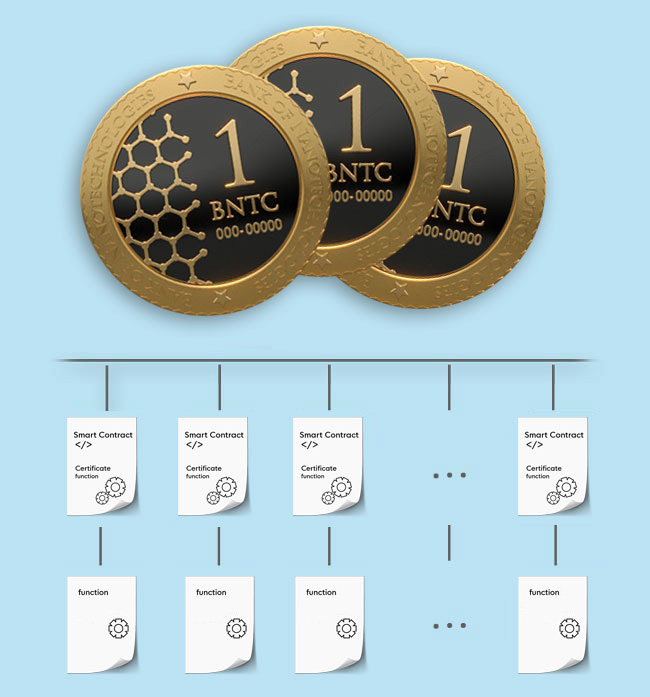
After testing the technical capabilities of the trading platforms, BNTC NFTs may be available for purchase on the trading platforms: Enjin, Rarible, OpenSea.
Target audience
The project's target audience includes several key groups:
Telegram channel concept
The channel's mission:
To provide opportunities, practical knowledge, tools, and inspiration for the successful commercialization of science-intensive innovative ideas, products, and technologies, transforming scientific achievements and innovative solutions into profitable businesses.
The channel's base cryptocurrency is USDT and TON.
Airdrop NFT
Goal: To create an active community that is motivated and interested in the project's development.
Shared Pool: 10,000 BNT NFT tokens.
Mechanism: Complete a task through a series of sequential actions to receive tokens. Examples: write a review about the project, post our banners on your Telegram channel (social media), confirm with a screenshot, or send a wallet address.
Reward: 1 token per review (at least 1,450 characters without spaces).
Distribution: All tokens will be distributed one month after the end of the AirDrop campaign to the wallets from which the tasks were completed.
Ecosystem services are under development
System for assessing the commercialization potential of a project (startup)
To offer users a tool to help them decide whether to invest in business startups in the ecosystem, we are developing a project (startup) commercialization potential assessment system.
The Innovation Commercialization Potential Assessment Service (ICPAS) is an AI-based software solution for assessing the commercial potential of early-stage R&D.
The goal of our service is to assist users and provide reliable information to decision makers.
The software uses mathematical models to calculate the ranking of various factors (groups of factors) for evaluating traditional and innovative high-tech technologies, distribute factors according to a weighting system, and defuzzify (eliminate fuzzy results in mathematical calculations) the evaluation criteria indicators.
Using ICPAS, decision makers can obtain important additional information at the early stage of technology commercialization.
The comprehensive assessment is based on analysis five key blocks of factors, each of which includes a number of measurable criteria: